The knee joint plays an important role in walking, running, jumping, and maintaining body balance. It contains several ligaments that connect the bones and provide stability during movement. One of the most important is the Anterior Cruciate Ligament (ACL), which helps control knee movement and prevents the shin bone from sliding too far forward.
An ACL injury is common among people involved in sports and physical activities. However, it can also occur during everyday activities involving sudden twisting or an awkward landing. Understanding the causes, symptoms, diagnosis, and available treatment options can help patients make informed decisions about their knee health. Early evaluation by an arthroscopy surgeon in jaipur can help determine the severity of the injury and the most appropriate treatment approach.
1. What Is the ACL and Why Is It Important?
The Anterior Cruciate Ligament is one of the four major ligaments in the knee. It connects the thigh bone (femur) to the shin bone (tibia) and provides stability during activities that involve sudden changes in direction.
The ACL performs several important functions:
- Controls forward movement of the tibia in relation to the femur.
- Helps maintain knee stability during turning and pivoting.
- Supports balance during running and jumping.
- Helps control rotational movements of the knee.
An ACL tear can affect these functions and make certain physical activities difficult. The severity of the injury may range from a minor ligament stretch to a complete rupture.
2. Common Causes of ACL Ligament Tears
ACL injuries frequently occur during activities that put sudden pressure on the knee. They are particularly common in sports such as football, basketball, badminton, and skiing.
Some common causes include:
- Sudden Direction Changes: Quickly changing direction while running can place excessive stress on the ACL.
- Incorrect Landing: Landing awkwardly after a jump may cause the knee to twist or bend abnormally.
- Sudden Stops: Abruptly stopping while running can increase pressure on the knee ligament.
- Direct Impact: A collision or strong blow to the knee may damage the ACL.
- Accidental Twisting: Slipping or falling with the foot fixed on the ground can cause the knee to rotate suddenly.
Not every ACL injury occurs during sports. Everyday accidents and falls can also result in ligament damage.
3. Symptoms of an ACL Tear
Symptoms can vary depending on whether the ligament is partially or completely torn. Some people experience immediate pain, while others notice increasing discomfort and instability over time.
Common symptoms include:
- A popping sound or sensation at the time of injury.
- Sudden knee pain.
- Swelling within a few hours.
- Difficulty walking or putting weight on the affected leg.
- A feeling that the knee may give way.
- Reduced range of motion.
- Difficulty running, jumping, or changing direction.
Persistent knee instability should not be ignored. An untreated ACL injury may increase the risk of additional damage to other knee structures, including the meniscus and cartilage.
4. Different Grades of ACL Injuries
ACL injuries are generally classified into three grades according to the extent of ligament damage.
Grade 1 – Mild Injury: The ligament is stretched but remains intact. The knee generally maintains stability, although mild pain and swelling may occur.
Grade 2 – Partial Tear: The ligament is partially damaged, resulting in some loss of stability. Symptoms may include swelling, discomfort, and difficulty performing physical activities.
Grade 3 – Complete Tear: The ACL is completely ruptured, often causing significant knee instability. Surgical treatment may be considered, particularly for people who want to return to sports or activities requiring frequent turning and pivoting.
The appropriate treatment depends on the injury grade, associated damage, activity level, and individual needs.
5. How Is an ACL Tear Diagnosed?
Accurate diagnosis is important for understanding the extent of ligament damage and planning treatment. An orthopaedic specialist usually begins with a detailed discussion about how the injury occurred and the symptoms experienced by the patient.
Common diagnostic methods include:
Physical Examination: The doctor checks knee swelling, movement, tenderness, and stability. Special tests, such as the Lachman test and anterior drawer test, may help identify ACL damage.
X-Ray: An X-ray helps identify fractures or other bone-related injuries. However, it does not directly show the ACL because ligaments are soft tissues.
MRI Scan: Magnetic Resonance Imaging provides detailed images of soft tissues, including ligaments, cartilage, and menisci. It helps confirm an ACL tear and identify associated injuries.
The doctor considers the examination findings and imaging results before recommending a suitable treatment plan.
6. What Is Arthroscopic ACL Treatment?
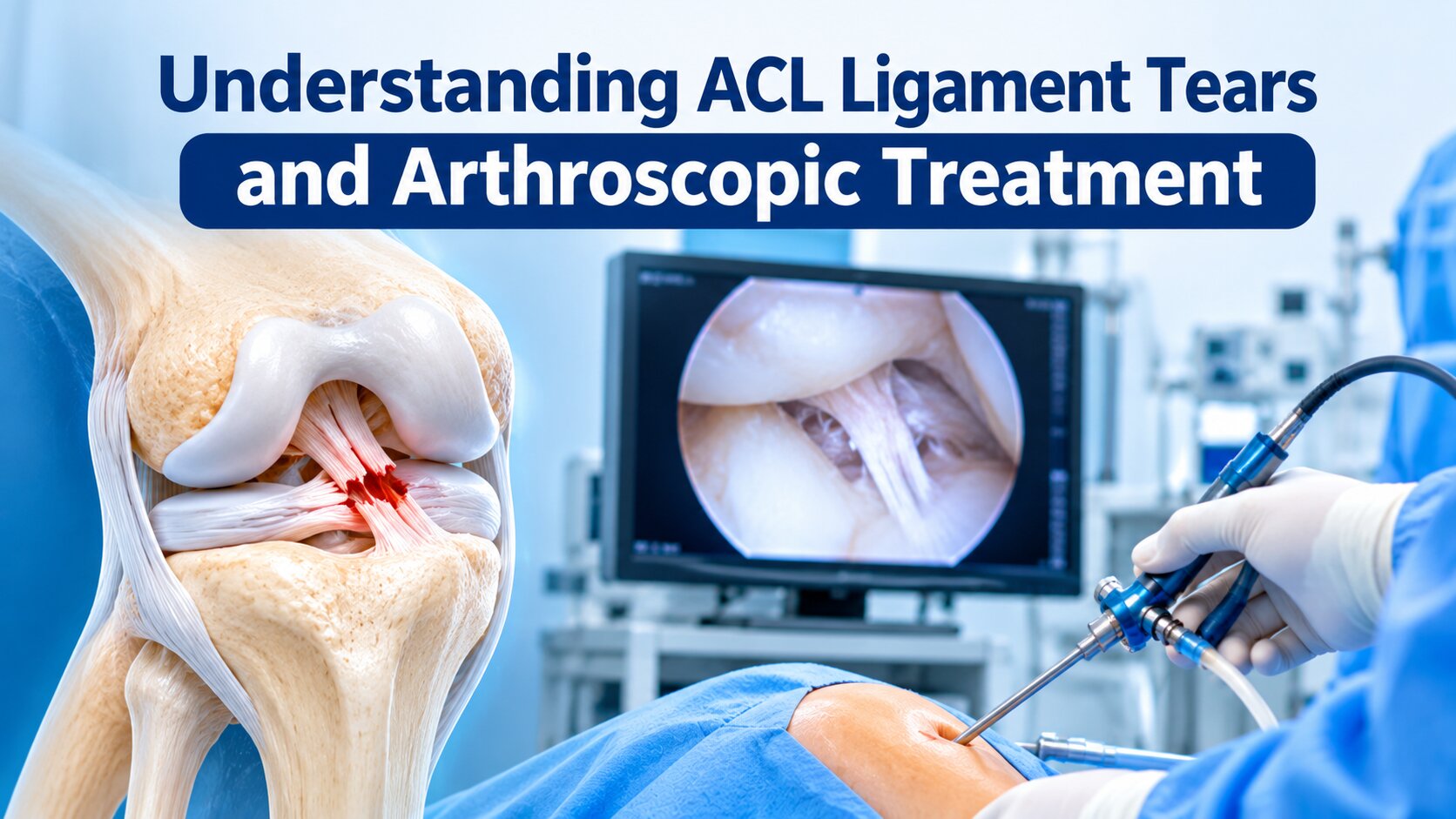
Arthroscopy is a minimally invasive surgical technique used to examine and treat problems inside a joint. During the procedure, the surgeon makes small incisions around the knee and inserts an arthroscope, a thin instrument equipped with a camera.
The camera displays images of the joint on a monitor, allowing the surgeon to examine the damaged structures and perform the required procedure using specialised instruments.
For a complete ACL tear requiring surgery, arthroscopic ACL reconstruction is commonly performed. Instead of simply stitching the torn ligament, the surgeon generally uses a graft to create a replacement ligament.
Patients looking for an arthroscopy hospital in jaipur should consider the availability of experienced orthopaedic surgeons, diagnostic facilities, surgical support, and structured rehabilitation services.
7. How Is Arthroscopic ACL Reconstruction Performed?
Arthroscopic ACL reconstruction generally involves several carefully planned steps.
Preoperative Assessment: The patient undergoes a clinical evaluation and required investigations to assess overall health and knee condition.
Anaesthesia: The procedure is performed under suitable anaesthesia, based on the patient's medical condition and the anaesthetist's assessment.
Small Incisions: The surgeon creates small openings around the knee to insert the arthroscope and surgical instruments.
Graft Preparation: A suitable graft is selected. It may be taken from the patient's own tissue, commonly from the hamstring or patellar tendon, or from another approved source when appropriate.
Reconstruction: The damaged ACL is addressed, and the graft is positioned through carefully created bone tunnels. It is then secured using suitable fixation devices.
Final Assessment: The surgeon checks the reconstructed ligament and knee movement before completing the procedure.
The exact surgical technique depends on the patient's age, activity level, injury pattern, and associated knee damage.
8. Recovery and Rehabilitation After ACL Surgery
Recovery after ACL reconstruction takes time and requires a structured rehabilitation programme. Surgery alone does not restore complete knee function. Physiotherapy plays an essential role in improving strength, flexibility, balance, and joint stability.
The rehabilitation process generally includes:
- Initial Recovery: Managing pain and swelling while following the surgeon's instructions regarding weight-bearing and knee movement.
- Restoring Movement: Gradually improving knee bending and straightening through guided exercises.
- Strengthening: Building strength in the quadriceps, hamstrings, and surrounding muscles.
- Balance Training: Improving coordination and control of the operated leg.
- Functional Training: Gradually introducing activities such as walking, jogging, and sport-specific movements when medically appropriate.
Returning to sports should be based on functional assessment and recovery milestones rather than a fixed timeline. Many patients require several months of rehabilitation, and returning to high-demand sports may take around 9–12 months or longer.
9. Benefits of Arthroscopic ACL Reconstruction
Arthroscopic reconstruction offers several potential benefits for suitable patients.
- Small Incisions: The procedure uses smaller surgical openings compared with traditional open surgery.
- Detailed Joint Visualisation: The camera allows the surgeon to examine the internal structures of the knee.
- Treatment of Associated Injuries: Certain meniscus and cartilage problems may also be addressed during the procedure.
- Improved Knee Stability: Reconstruction can help restore stability when combined with appropriate rehabilitation.
- Return to Physical Activities: Many patients can gradually return to their desired activities after completing recovery and meeting functional criteria.
The results depend on several factors, including the extent of injury, surgical technique, rehabilitation, and patient commitment.
10. Choosing the Right Orthopaedic Care
Selecting the right medical facility is an important part of ACL injury management. Patients should look for an experienced orthopaedic team, appropriate diagnostic facilities, modern surgical infrastructure, and access to post-operative physiotherapy.
When comparing options for the best orthopedic hospital in jaipur, consider the surgeon's experience in knee ligament procedures, availability of arthroscopic facilities, rehabilitation support, and the quality of patient care.
A proper treatment plan should be based on individual assessment rather than a standard approach for every patient.
Conclusion
An ACL tear can affect knee stability and make everyday movement or sports activities difficult. However, timely diagnosis and suitable treatment can help patients manage the injury and work towards restoring knee function. Arthroscopic ACL reconstruction is an established option for selected patients with significant ligament damage, while rehabilitation remains essential for long-term recovery.
Understanding the injury, following medical advice, and completing a structured physiotherapy programme can support a safer return to daily activities and sports.
Frequently Asked Questions (FAQs)
1. What is an ACL ligament tear?
An ACL tear is an injury to the Anterior Cruciate Ligament, which connects the thigh bone to the shin bone and helps maintain knee stability. It can be a partial or complete tear.
2. Can an ACL tear heal without surgery?
Some ACL injuries can be managed without surgery through physiotherapy, activity modification, and supportive treatment. Surgery may be recommended for complete tears causing instability, especially in physically active individuals.
3. Is arthroscopic ACL surgery a major procedure?
ACL reconstruction is a specialised surgical procedure, even though it uses small incisions. It requires proper surgical planning, anaesthesia, post-operative care, and rehabilitation.
4. How long does recovery take after ACL reconstruction?
Recovery varies between individuals. Many patients need several months of rehabilitation, while returning to high-demand sports may take around 9–12 months or longer, depending on functional recovery.
5. Is physiotherapy necessary after ACL surgery?
Yes. Physiotherapy is essential for restoring knee movement, muscle strength, balance, and stability. It also helps patients gradually return to their regular activities